

Scrapbook #6
The Economics of the Art World - Part 1: The Art Market

Often wondered why art collecting is so expensive and why the prices and consequently the market that sets these prices is so opaque? Did you ever wonder what is the difference between the primary market and the secondary market? What is fractional ownership of art? Why are prints and photography sold in multiples? What are limited editions? What are the network effects in an art market? Why is one artist’s works more expensive than others? Why can't I walk into Gagosian and purchase an Anselm Kiefer?
Welcome to Scrapbook’s next series on the Economics of the Art World, which attempts to chart the economics underlying the Art World, and its oft-changing dynamics.
Before we kick off, a few necessary disclaimers: First, I do not have a PhD in economics, so any inferences drawn in economics are necessarily open to correction and verification. Second, my experience in the art world and market is practical experience, as a gallerist - which does touch on many aspects in the market, but is nuanced and based in experience - as such an overview or wider viewpoint is extrapolated from there and through publicly available information. And lastly, I’m not an investment advisor, so anything that borders on investment advice is not intended to be investment advice or to be taken as such.
I am, however, a relapsing gallerist. I founded The Guild, a gallery focused on emerging and contemporary South Asian art in New York in 2007 and closed it in 2012 - so I have had a front row seat to the Art World from a decidedly South Asian perspective. If the term gallerist does not sound pretentious, I don't know what does. The Art world is pretentious, precious, and impenetrable by design - but it is also exciting, challenging, and rewards those whose risk tolerance is on the high-side.
Here’s a distinction to be made at the very start - the Art World is not the art market, although it may seem like it given the coverage that high auction prices often receive. The Art World is far more comprehensive, consisting of many players. Everyone from galleries and gallerists, artists, auction houses, Art fairs, museums, curators, NFT collectors, old school collectors, Gen X, Y, and Z collectors, dealers, academics, writers, and more, have a part to play in this world.
The Art Market
For this series, we’ll start with the Art Market, which is not an efficient market by design or definition. It is estimated to be a $65bn global market, with largely non-fungible products, limited immediate liquidity, high barriers to entry, and a purposefully light and uncoordinated regulatory regime - Basel II Rules this aint, though unironically Art Basel started off in Basel. Its an attractive and challenging market as I said for a particular type.
The market itself resolves into two main forms - the primary market (private) and the secondary market (public/private) - and there are players and transactions that muddy the distinction between the two (see below for a fine example). The primary market is where art works enter circulation by way of galleries, and sometimes artists, and increasingly a subset of art works enter the market by way of direct-to-market artists, or through platforms that work with artists to create limited edition prints or multiples. In the primary market the relationship between the artist, their gallery or platform, and the contract of representation, whether formalized or not, is the driving relationship that brings art work to the market.
Important here to state that primary market prices are not public - data regarding gallery sales and private deals is not readily available. Primary market data is also not freely available - in that proprietary platforms like Artsy, for e.g. may have galleries publish prices on their platform, but not all listings come with price tags, and any data they gather is used internally - in short, unlike auction houses, primary market players are not required to report on prices - making the primary market decidedly opaque.
In the secondary market the artwork enters the market by way of auction houses, galleries consigning work to an auction, or through collectors, consigning work to an auction, or to an advisor to sell. See how muddy this can get? A collector can place a work with an advisor or the gallery from which they bought the work to sell on their behalf - in either case, the prices are not publicly available. If a collector consigns a work to auction and if the work sells at auction, that price is publicly available, and sets a benchmark - a duality that we will return to - but even then, comes with the financialization of guarantees, which are not often publicly available information.

Damien Hirst, For the Love of God, 2007
One fantastic example of the crossover between private markets and public markets is the famous studio-to-auction by Damien Hirst and Sotheby’s in 2008, titled, Beautiful Inside My Mind Forever, with the diamonds on the cover page of a catalog that cost nearly $240,000 to produce. The artworks were all by Hirst, and were specifically made for this auction. They traveled as an exhibition to several locations including New York, and New Delhi on a preview tour for buyers to view. All in all 223 new works would go under the hammer in London.
On September 15 & 16, 2008, Sotheby’s hammered down $200M in sales on the Hirst auction. Damien Hirst walked away with $172M. That same morning. Lehman Brothers collapsed kicking off the Great Financial Crisis. I still have the catalogue in storage somewhere.
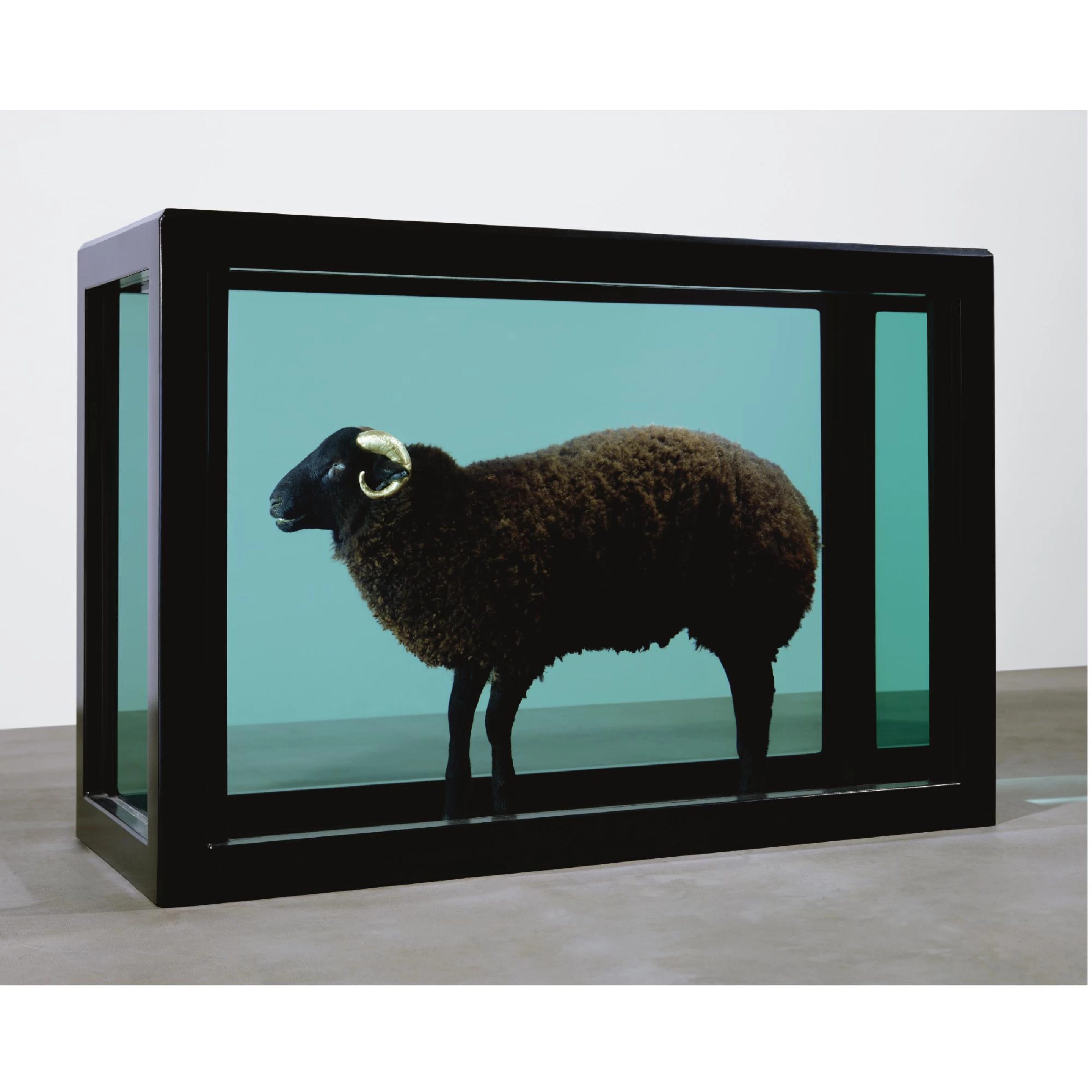
Damien Hirst, The Black Sheep with the Golden Horn, 2008
So far from being a normative market, the art market is idiosyncratic, lacking in price transparency and liquidity, and opaque to the point where the data available sheds light on, at best, fragments of the market, and yet is endlessly cited to make the case for a bull or bear market.
The most famous of these is the Art Basel & UBS’s (the Swiss bank that swallowed up Credit Suisse last year) Art Market Report. Art Basel, of course is one of two largest art fairs in the world, alongside Frieze - both of which have many iterations in many of the largest markets in the world - think Paris, New York, Hong Kong, Seoul, Miami, Los Angeles, and of course, Basel of banking regulation fame, in Switzerland.
The Art Basel and UBS Art Market Report 2024 provides a review of the international art market, highlighting some of the most important trends and developments taking place each year. Authored by Dr. Clare McAndrew, founder of Arts Economics, the report is an independent and objective study, analyzing sales and other activities of different segments of the market including galleries, auction houses, art fairs, and collectors.
Notable here is the intersection of a leading art market report sponsored by a global bank which also is the main sponsor of the Basel art fair, after which this report is named. There is an assumption of few if any conflicts of interest in this relationship and it is the underlying theme of much of the art market. Why? Because there is precious little regulation of the market as such, and of what there is, it is broadly applicable to larger players, while different players like artists, galleries, museums etc. are governed by general business law. But this is not securities law by any means. With the exception of the auction houses, which in New York, are even less regulated than they were in the past.
For example, according to the Center for Art Law, in April 2022, New York’s City Council repealed long-standing regulations governing auction houses, that required auction houses to:
Obtain a license and exclusively employ licensed auctioneers
Stipulated that auction houses retain records for a minimum of 6 years, to be accountable and provide clear attribution and title
Provide written consignment agreements disclosing fees and title
Disclosure of financial arrangements between auction house and consignor such as load advances and guarantees
Regulations also required auction houses to not to publish estimated values below the reserve price
And regulations provided oversight of chandelier bidding - a practice whereby auctioneers playacted bids as warm up to generate interest.
It was part of a broader effort to stimulate business activity post-pandemic, primarily involving eliminating rules that had been enacted in the 1980s to bolster oversight within an industry known for its opacity.
Legislators intended the original regulations to safeguard buyers’ interests by ensuring disclosure of crucial information, particularly in cases where auction houses held a financial interest in the items being sold. Due to the nature of the art market, the regulations were narrowly tailored to govern auctions involving art and collectibles.
Nevertheless, despite numerous arguments advocating for increased transparency in the art market and auction industry, an equal number of voices contend that more regulatory intervention is unnecessary. This perspective is shared by Jane A. Levine, former Senior Vice President and Compliance Director for Sotheby’s. According to Levine, “people like to say that the art market is unregulated. Nothing could be further from the truth. There are bespoke auction rules that cover this very tiny market that actually do govern the auction process.
While the repeal has surprised many due to its unforeseen nature, it seems unlikely to result in as much change as some may have feared. Disclosures, which improve transparency, consistency, and equal access to information, as well as upholding ethical standards, contribute to client confidence and serve the interests of both auction houses and their clientele. Due to the pervasive lack of transparency in the art market, discerning any changes will always remain challenging. Nevertheless, given the significant financial stakes involved in these auctions, clients are unlikely to persist in participating if they perceive any form of exploitation or mistreatment. Consequently, one could contend that even in the absence of specific regulations, the industry is incentivized to uphold these practices for the preservation of the auction process’s integrity. Furthermore, the deregulation might even present an opportunity for auction houses to demonstrate their dedication to ethical standards and to their clients. This could potentially distinguish them from other players in the industry that may choose to embrace the new freedoms.1
And that is the case in New York. Auction houses adhere to different rules in France, where VAT on art purchases has recently been lowered, and where by law artists receive a % of sales made in the secondary market. In this, and across many markets, there are opportunities for arbitrage in taxes and incentives for collectors and sellers, between markets, and in an idiosyncratic marketplace of non-fungible products. Now isn't that fascinating?!?!
Products, Pricing, and Value
Finally we come to the products circulating in this market; artworks are produced in various forms, sizes, mediums, formats etc. Most are unique and non-fungible, with the exception of prints, multiples, and editions, and what stands out in those are the size and number of the editions issued.
So for example, a sculpture is cast from an original master made by the artist. The artist then issues say 10 editions of the master, which means there are 10 copies of the master, which are sold as 1/10, 2/10 and so on. These are limited editions, which carry greater exclusivity as their limited number curtails the sale of further copies, which adds to their appeal. Sculptures often have shorter editions since production for larger sculptures can be expensive. However, for smaller sculptures, or objects, like the Jeff Koons balloon puppy in the tiniest sizes, whose editions can be as large as 250 or even an open edition - which consequently impacts the price per sculpture - these are called multiples. The lower the edition the higher the pricing, is a decent rule of thumb. Editions of photography and prints also largely follow the same rules.
Then there is the question of value. Pricing and value here are correlated but it isn't a direct correlation. Value depends on many aspects, not the least of which is the brand of the artist, their gallery representation, which museum collections the artist's works are placed in, auction prices, relational buzz, aesthetic significance and finally cultural significance - not so much relational aesthetics as it is relational valuation. Of these, auction prices, museum collections, the name of the gallery are the only publicly available information, when it actually is - in that not all artists have had artworks sold at auction and do not have a public secondary market hammer price.
Prices, however, are not wholly set openly in the market, except in the secondary market. Primary market prices, especially for emerging artists, are benchmarked against peers with similar aesthetic considerations, ages, and other relational valuation benchmarks, with galleries and artists applying premiums based on a number of complex factors.
Are all prices subjective? No, but prices are fluid depending on context - there is a simplified version of price discovery in place, similar to price discovery in the commodity markets.. That does not make the products commodifiable at the scale at which it can be standardized, like a commodity, with little variable differentiation.
Does price discovery equate to valuation? That duality that is set at auction through the hammer price (the final and highest price without buyers or sellers commission or taxes - kind of like EBITDA) also hammers the value for an individual work of non-fungible art at the point that it is sold - that is the equation in this market of price to valuation.
When another equivalent art work by the same artist comes to auction, the previous auction record will provide a benchmark against which the current one is priced - rarely are they priced lower - they may be hammered lower, but not priced lower. Here then is the artifice/assumption of correlation - if I or anyone else sells a Basquiat for $XXX at auction, the valuation of all the other Basquiats I may own, or others might that are nearly equivalent based on aesthetic considerations (period, size, provenance, and condition), are presumed to be valued at that public price - even if its not explicitly so. While this is a reasonable pricing/valuation strategy, this is a pricing/valuation strategy in a market of largely non-fungible products, with limited liquidity - setting a valuation of assets that are difficult to sell based on subjective past valuations! No where has the disclaimer, ‘past performance is not indicative of future results’ been more apt.
How does the market arrive at valuation? In financial markets valuation is the present value of presumed future cash flows of an asset, but unless a given painting is commodified, whether that is as an image that is licensed or part of a collection which is collateralized, most paintings do not generate revenue in and of themselves. There aren't earnings associated with an individual painting so future cash flows for a gallery or an artist who owns a work (singular), aren't counted as future cash flows, but for a gallery or a collector, a collection or artworks can be collateralized - so there is some underlying agreed upon valuation to be arrived at, which can then be leveraged.
From a 2021 study titled, Reading between the lines in the art market: Lack of transparency and price heterogeneity as an indicator of multiple equilibria2, by Juan Prietro-Rodriquez and Marilena Vecco, writing in the journal of Economic Modeling:
Prices in the art market are heterogeneous, and the variance artwork prices is due to the large heterogeneity of works, in terms of their measurable variables and aesthetic dimensions and factors external to the artwork such as an exhibition record, network effects, speculation, auction houses, attributional and expert opinion. Furthermore, some determinants of art prices are consistent with the use of inside information (which is not forbidden), as the lack of transparency might be beneficial for those for whom it is available. The lack of transparency could help increase price disparity, but even if it were not one of the causes of this heterogeneity, it is clear that it makes the research and analysis of this market difficult. Therefore, the art market cannot be described as efficient, mainly because price formation is opaque to outsiders that lack information about unsold artworks (David et al., 2013).
In a delightful coincidence, I found this research paper, which focuses on analysis of prices of artworks from the surrealist movement, in the year that surrealism celebrates its centennial. The basic research question here is whether finite mixture models (FMMs) - which is a statistical model that assumes that data comes from a population that is a mixture of underlying probability distributions - can enable the writers to reject the hypothesis of a unique segment in the art market characterized by a single deterministic price structure and ALTERNATIVELY, if it can prove the existence of more than one segment with its own price structure. From the paper:
The main assumption of FMMs is the heterogeneity of the underlying “population” of analysis. It means that this population is made up of a set of sub-populations that are characterized by specific parameters. By applying FMMs, it is first possible to enumerate this heterogeneity and second, create a typology characterizing unique sub-populations. Because of their flexibility, FMMs are assumed to be more useful for modeling unknown distributional shapes. This is on the top of their obvious applications in contexts in which there is group structure in the data or the data to determine such structure are to be explored. In a nutshell, FMMs have characteristics making them suitable for art market research, namely, the capacity to identify and describe price heterogeneity, but also to analyze how prices affect and shape the structure of the art market.3
I will try and summarize the results, but it's worth reading the whole paper (see footnote above). The dataset used is a sample of 8822 paintings from the surrealist school sold at auctions between 1990 and 2007 related to different schools.
The study finds that there is no unique auction price structure for Surrealism, by identifying three statistically differentiated segments in the data set. These segments differ according to the artworks auctioned in each of them, with the most well-known artists allocated to the most expensive segments.
Paintings auctioned in New York, Milan, Rome, and London are associated with higher prices. Amsterdam, Cologne, Vienna, and Stockholm seem to trade art at lower prices, especially at the most expensive segment of the art market. Sotheby's and Christie's could sell works of art at higher hammer prices than could be obtained in other auction houses. This is what they call the direct effect. Yet, they may also be more able to reallocate works of art to more expensive segments than if these paintings were auctioned by other auction houses - giving the two main auction houses an advantage because they have the presence in those high-value markets. By doing this, they shape different market segments at the high end of the art market. These effects depend on their expertise and reputational capital and the value that bidders give them, but not necessarily on their potential market power.
That is a surprising finding —a heightened reputation will attract both better bidders (with a higher willingness to bid) and better works of art (with better unobservable characteristics). These artworks, therefore, will be more expensive within a particular market segment (direct effect), and their natural allocation will be to more expensive segments of the art market (indirect effect). On the other hand, given the market share of Christie's and Sotheby's, they could exert some market power that could affect hammer prices and not just sellers' commissions. However, prices are not directly fixed by the auction house but by the bidder with the highest willingness to pay. So the study does not rule out the existence of market power, it can only be exerted to raise the prices of works of art through what they call the indirect effect, that is, auction houses can attract bidders with a high willingness to bid to the more expensive art market segments that they, in turn, also help to shape.
The study believes that this can be understood as empirical evidence supporting the hypothesis that a lack of transparency in the art market is a signal of the existence of different segments in this market, and moreover the ability to choose which market to place an artwork in, rather than an ‘open market’ harks back to the movement of traders between markets- something a regulator doesn't really allow without registration. However, if I wanted to sell a Basquiat on the secondary market, Sotheby’s or Christie’s might put that in a sale in NY v. a sale in Amsterdam (using the market segments in the study as an example), in order to place the work at a higher estimate and while I would need to sign a consignment agreement, I wouldn't need to register as a company in London in order to sell - this isn't apples to apples, but the mobility of assets with an underlying financial value, especially assets like a Basquait with an established market (with lots of past valuations), across markets with little or no regulation is extraordinary, and yet normal in the art market - and this is the power of Sotheby’s and Christie’s, not just price-setting.
Next week, we dig into that aforementioned Art Basel report as a proxy for an underlying model that has assumptions and premises, to tease out what principles of economics presume to apply to this inefficient market and which don't. Stay tuned, subscribe and give feedback below!
https://itsartlaw.org/2024/04/11/unexpected-deregulation-new-york-city-shakes-up-art-market-by-repealing-long-standing-auction-industry-regulations/#post-64111-footnote-1
https://www.sciencedirect.com/science/article/pii/S0264999321001760?via%3Dihub
https://www.sciencedirect.com/science/article/pii/S0264999321001760?via%3Dihub
Great article! Can’t wait for the next one !!